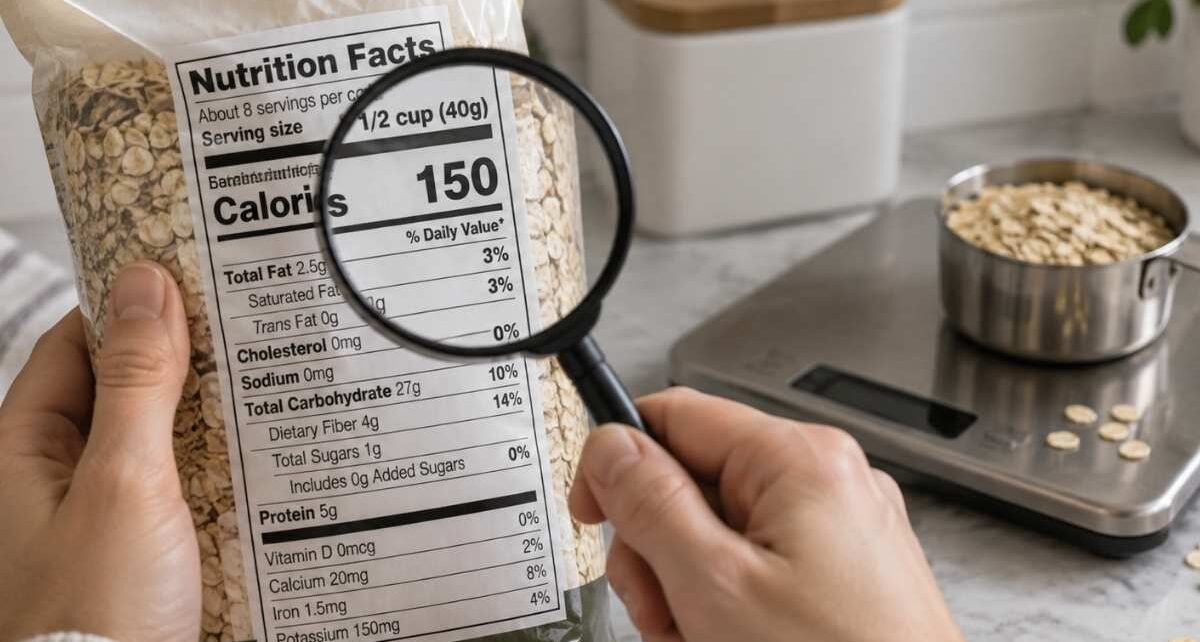
A package of cookies can say 150 calories per serving and still raise a good question: how closely must that number match the food inside? The answer depends on the rules behind the label and the way the product is tested.
Does the calorie count on a nutrition label have to be accurate? Not completely. Under U.S. FDA regulations, certain deviations are allowed. The permitted range is larger than many readers may expect.
We also looked at a study that measured calorie values in popular packaged snacks. It offers a useful comparison between the label and the laboratory result.
- The U.S. FDA generally allows up to 20% more calories in a tested sample compared with the declared value, subject to the prescribed measurement tolerance.
- A product labeled as having 200 calories can contain 240 calories under the basic rule.
- A laboratory analysis of 24 types of packaged snacks found a median of 4.3% more calories than stated on their labels.
- A product with fewer than five calories per serving can be labeled as having zero calories.
- Serving size often makes a bigger difference to your daily calorie count than the discrepancy on the label itself.
Did You Know That a 20% Deviation Is Allowed?
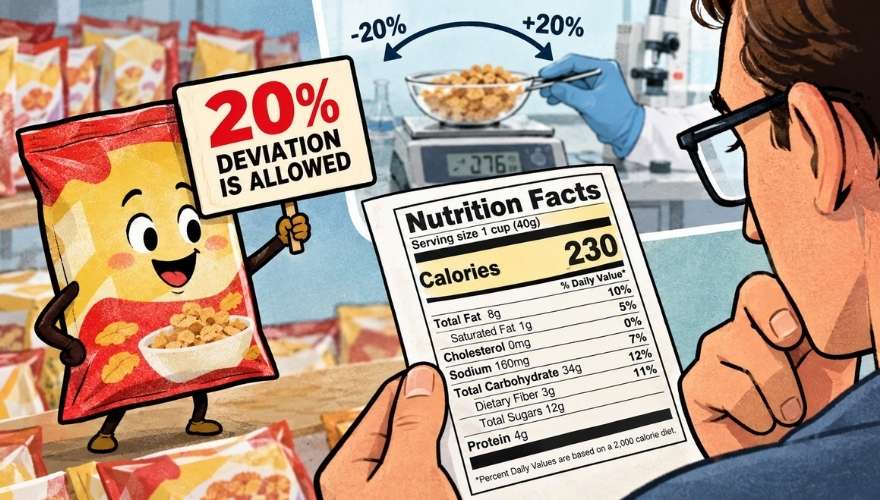
An exact match between a nutrition label and a laboratory result sounds reasonable, but U.S. rules allow a defined tolerance.
Under U.S. regulation 21 CFR 101.9, the calorie content of a laboratory-tested sample generally must not exceed the declared value by more than 20%, subject to the prescribed tolerance of the measurement method.
However, there is one important thing you should know. The permitted deviation does not mean that every product contains 20% more calories, nor are manufacturers allowed to deliberately provide inaccurate information.
A standard laboratory test uses a composite sample of 12 individual units from the same production batch.
Why Aren’t Calories on Nutrition Labels Completely Accurate?
Perhaps you’ve wondered how a manufacturer knows how many calories each serving contains. Does it really test every package that leaves the factory? Of course not.
Nutrition calculations may rely on laboratory results or ingredient data rather than a separate test of every individual package.
Manufacturers can use laboratory results or appropriate ingredient data. One of the standard calculation methods is based on the amount of protein and carbohydrates, which provide approximately four calories per gram. However, raw ingredients are not completely identical.
Differences in water content or the composition of individual ingredients can affect the final result. The details are explained in the FDA’s guidelines for calculating nutritional values.
How Can a Product Say Zero Calories?
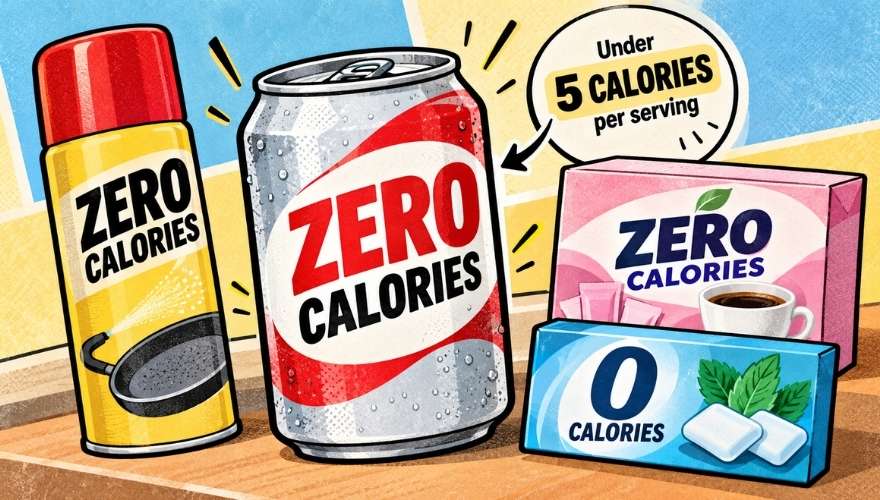
Have you ever bought a product labeled as having zero calories and thought you could consume it without taking in any energy? Under U.S. calorie labeling regulations, a food with fewer than five calories per serving can be labeled as having zero calories.
Values up to 50 calories are rounded to the nearest five, and values above 50 are rounded to the nearest ten. So even a correctly labeled product does not necessarily display its exact energy content.
Let’s Imagine the Following Situation…
We have a 150-gram package of cookies in our hands. The label says 200 calories per serving, but one serving is only 50 grams. If you eat the entire package, you’ll consume 600 calories according to the label.
Serving sizes can be surprisingly small compared with the amount someone actually eats. Does that automatically mean the label is wrong?
Not necessarily. The problem is that the figure of 200 calories does not represent the entire package.
Before calculating a portion, check the following:
- Serving size: The calorie count may refer to just a few pieces.
- Total number of servings: An entire package often contains several times the amount of food listed as one serving.
- Actual amount: A kitchen scale is useful when you need a more accurate calculation.
Perhaps You’ve Wondered Too…
Are Manufacturers Allowed to Deliberately Understate Calorie Counts?
No. The U.S. 20% rule represents a tolerance when verifying nutritional content, not permission to deliberately mislead consumers.
Should I Add 20% to Every Declared Calorie Value?
No. The permitted deviation does not represent the actual difference in every product. Some foods may even contain fewer calories than stated on their labels.
How Can I Check If a Nutrition Label Is Accurate?
A complete verification requires appropriate laboratory analysis. At home, you can measure your portion more accurately, but a kitchen scale cannot determine the actual energy content of food.
Conclusion
Use nutrition labels as a basis for estimating calories, but do not expect absolute accuracy. Serving size and the amount of food you actually eat often matter more than a small difference between the declared and measured values.