Older food labels offer an interesting record of how nutrition numbers and labeling rules have changed. One number has stayed remarkably familiar: a gram of fat is counted as 9 calories. We wanted to trace that familiar figure back to the original research and find out how it became the standard.
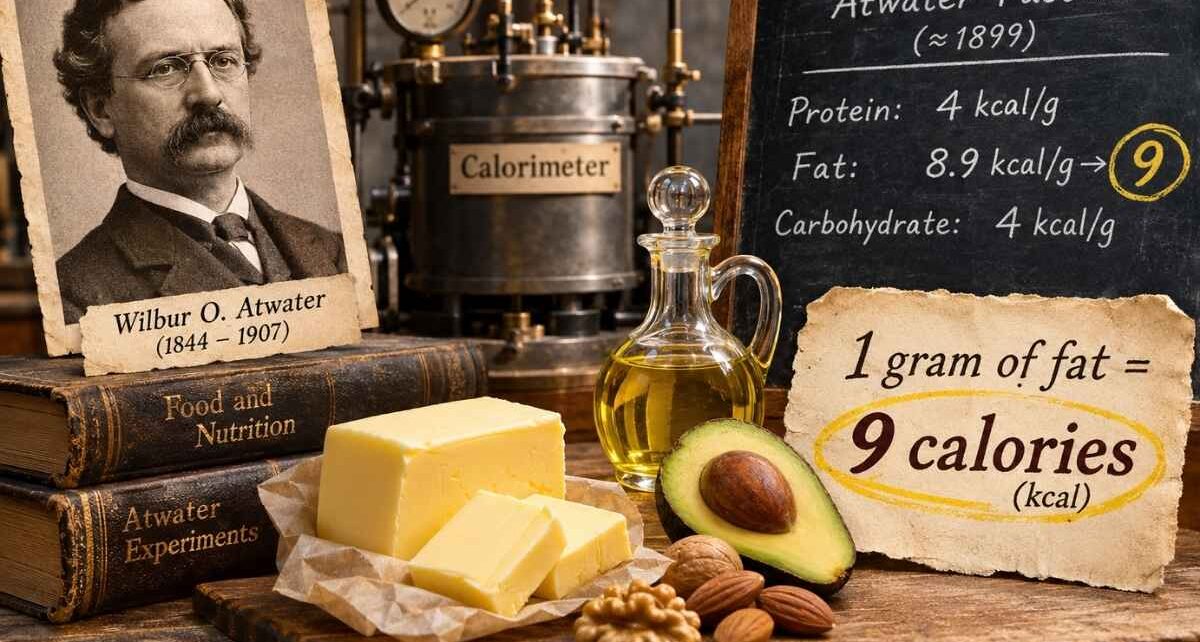
The answer leads back to American chemist Wilbur O. Atwater and his colleagues in the late 19th century. They did not simply decide that fat was worth 9 calories per gram. Their work combined measurements of the energy released by food with human digestion data to estimate how much of that energy was actually available to the body. Atwater’s average factor for fat eventually came out closer to 8.9 kcal per gram, which was later rounded to 9.
The familiar 4-4-9 formula is therefore the end of a much longer calculation.
The Number 9 Started Closer to 9.4
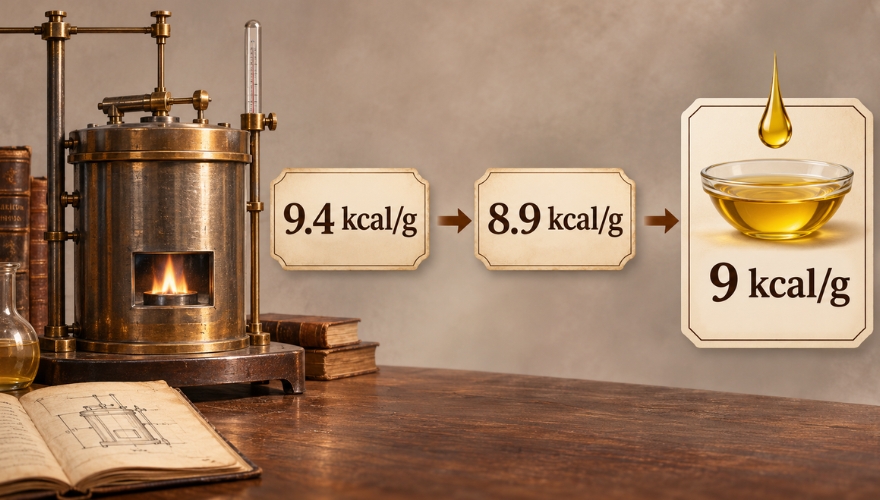
When fat is completely burned in a calorimeter, it releases substantially more energy per gram than protein or carbohydrate. Atwater and A. P. Bryant worked with gross energy values of roughly 4.4 kcal/g for protein, 9.4 for fat, and 4.1 for carbohydrate.
The next step was crucial. Energy released by complete combustion is not the same as energy available from food after digestion.
Atwater used digestibility data to correct those gross values. In 1899, he summarized results from 97 digestion experiments and arrived at average “fuel values” of approximately 4 kcal/g for protein, 8.9 for fat, and 4 for carbohydrate in mixed diets. Those values became the basis of what we now call the Atwater system.
So the modern 9 was not an arbitrary choice. It came from measurement, correction for digestibility, and finally a useful rounding of 8.9.
Atwater Was Measuring More Than Burned Food
The short version of the story usually involves a bomb calorimeter: put food inside, burn it, and measure the heat released. That covers only part of what Atwater was doing.
He wanted to know how food energy behaved in the human body. His research program included human digestion experiments, and he worked with physicist Edward B. Rosa on a respiration calorimeter that could measure energy expenditure in people. The first reported human experiments with that apparatus were conducted during the winter of 1895–96.
By 1898, Atwater and Charles Langworthy had compiled data from about 3,600 metabolism experiments involving food intake and subsequent excretion.
That distinction matters when reading a nutrition label. Gross energy describes what complete combustion can release. Metabolizable energy aims to describe the portion available to the body after relevant losses are accounted for.
A gram of fat can therefore release around 9.4 kcal under laboratory combustion conditions while the general factor used for food calculations is 9 kcal/g.
Nine Is Not a Physical Constant for Every Food
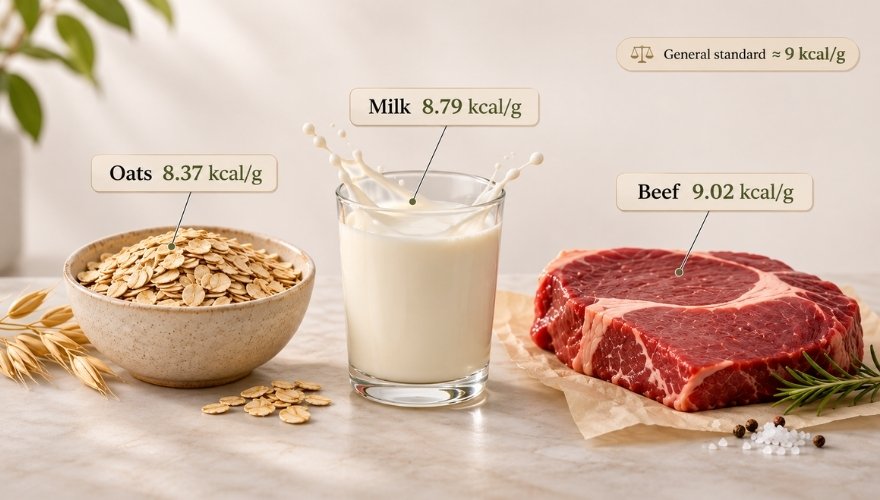
USDA does not use exactly 9.00 kcal for every gram of fat in every food when more specific information is available.
Its food-composition methodology includes specific Atwater factors that vary according to the food. Fat in milk, for example, uses a factor of about 8.79 kcal/g, while beef fat uses about 9.02 kcal/g. The factor listed for fat in oats is about 8.37 kcal/g.
| Food | Specific fat factor |
| Oats | 8.37 kcal/g |
| Milk | 8.79 kcal/g |
| Beef | 9.02 kcal/g |
Source: USDA food-composition methodology.
We find that table useful because it puts the familiar 9 on a label into perspective. The number works as a general factor. It does not claim that every gram of fat from every food will provide exactly the same amount of metabolizable energy.
USDA’s general calculation still uses the familiar formula:
Protein: 4 kcal/g
Fat: 9 kcal/g
Carbohydrate: 4 kcal/g
More specific factors can be used when the composition and energy availability of a particular food justify them.
Why We Still Use 9
A nutrition label needs a standardized method that can be applied consistently across an enormous range of foods. The 4-9-4 system does that without pretending to measure the exact energy every individual will absorb from every bite.
This video offers a quick look at why fat provides 9 calories per gram and how food energy is measured.
For a practical example of how fat contributes to the calorie content of everyday foods, take a look at how many calories are in olive oil.
That is also why newer research can refine calorie estimates for particular foods without making Atwater’s entire system useless. Food structure, digestibility, and processing can affect available energy, while the general factors remain useful for routine calculations.
The 9 calories per gram of fat on a label is best read as a standardized energy factor rather than a law of physics.
Atwater and his colleagues arrived at numbers such as 9.4 and 8.9 first. The neat 9 came later.