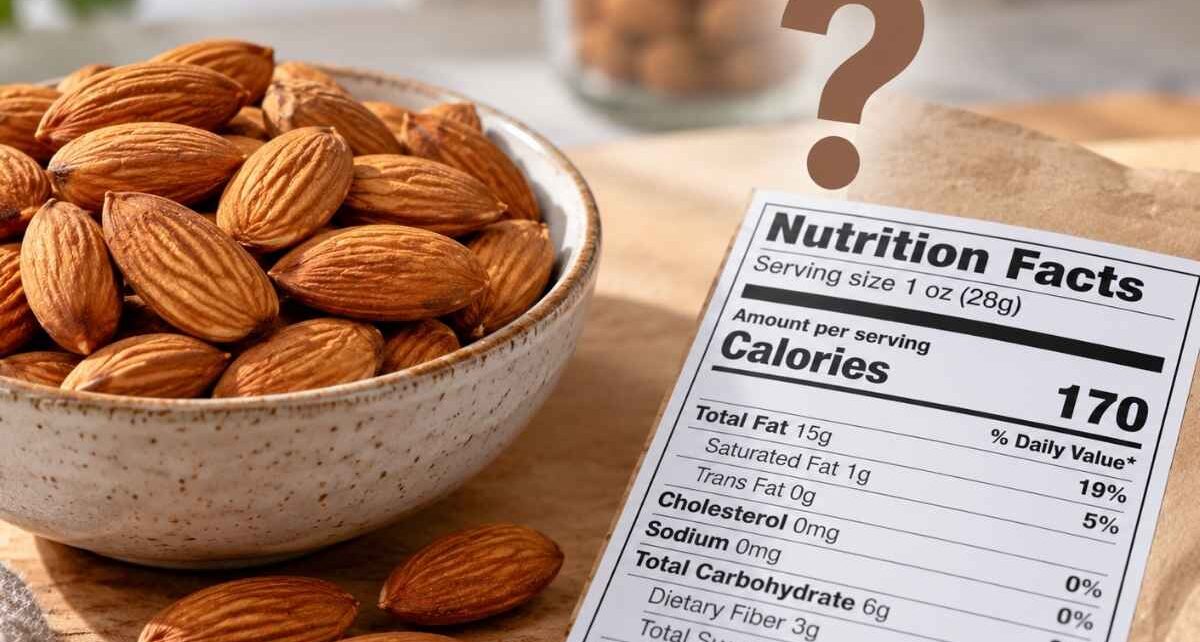
A calorie figure can come from direct measurement or from a calculation based on standard factors. That distinction matters especially for almonds, where food structure can affect how much energy the body absorbs.
The calorie count on almond labels may not reflect how much energy your body actually absorbs.
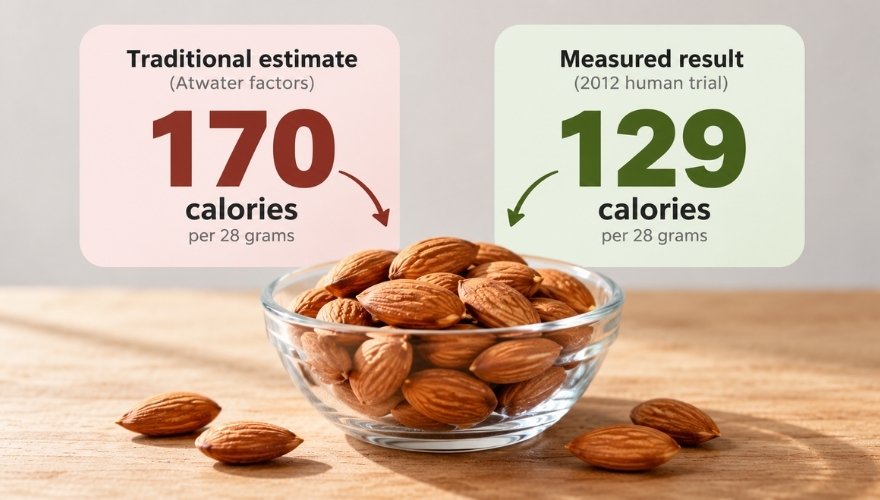
So do almonds have fewer calories than the label says? For whole almonds, human studies show that metabolizable energy can be lower than older Atwater-based estimates. A 2012 USDA study measured about 129 calories in a 28-gram serving, compared with the 168 to 170 calories predicted by standard Atwater factors.
That does not mean every almond label is wrong. The amount of energy available to the body depends partly on the physical form of the almonds, a distinction that matters more than the label alone might suggest.
How Did 170 Calories Become 129?
USDA researchers Janet Novotny, Sarah Gebauer, and David Baer tested the question in a controlled human trial published in 2012. Eighteen healthy adults ate controlled diets with different almond amounts, then researchers analyzed the diets plus urine and fecal samples to calculate metabolizable energy.
The measured result was 4.6 ± 0.8 kcal per gram.
A 28-gram serving therefore supplied about 129 metabolizable calories.
Traditional Atwater factors put the same serving near 168 to 170 calories.
The difference works out to roughly:
170 − 129 = 41 calories
The researchers reported that the Atwater method overestimated measured almond energy by about 32% in that trial.
Numbers like that show why a label should not be treated as a direct measurement of every calorie the body will absorb. Food labels need standardized methods, but a standardized estimate can miss something about the physical structure of a particular food.
Why Can Whole Almonds Release Less Energy?
An almond stores much of its fat inside cells with sturdy walls. Chewing breaks some of that structure, but not every cell opens enough for digestive enzymes to reach all of the fat.
Some energy therefore remains inside larger almond particles and leaves the body without full absorption.
A 2016 randomized crossover trial tested 18 healthy adults with whole natural almonds, whole roasted almonds, chopped almonds, almond butter, plus a control diet. The results make the role of food structure unusually clear.
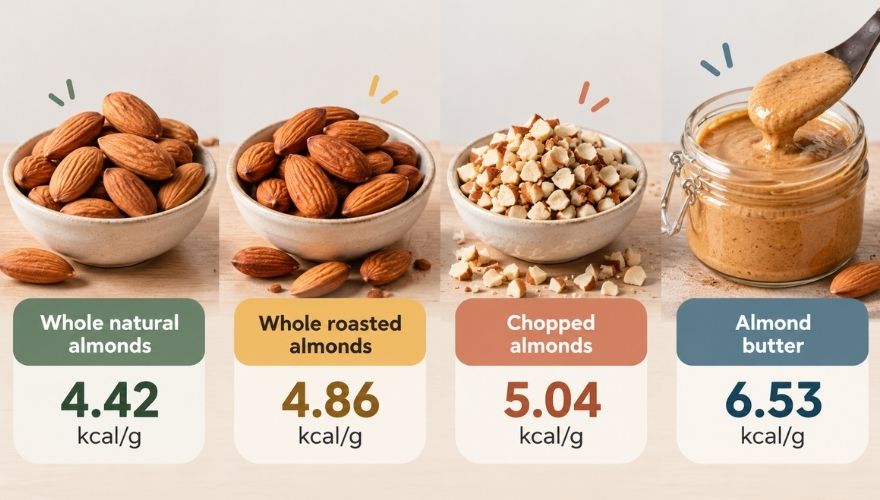
The table adds something the first study could not show. The form of the almond changed the amount of metabolizable energy, even though the food still came from almonds.
Whole natural almonds produced the lowest value. Almond butter came close to the value predicted by Atwater factors. David Baer summed up the point well: “Calories are created equal but their availability from foods is not equal.”
Almond Butter Is a Different Case

The almond butter result is a strong reason not to apply a blanket 20% or 30% calorie reduction to every almond product.
Once almonds become a smooth butter, much more of their internal structure has already broken apart. Digestive enzymes gain easier access to the fat, so more of the stored energy becomes available.
A separate human study on mastication also found that almond particle size had a major effect on lipid bioaccessibility. Larger particles left more fat trapped inside intact cell structures.
The 2016 trial found 6.53 kcal per gram for almond butter, close to the predicted value. Whole natural almonds came in at 4.42 kcal per gram. For a hypothetical 28-gram portion, that difference works out to about 59 calories.
That comparison is useful because both numbers come from the same controlled study. It shows why the phrase “almonds have fewer calories than the label says” needs a qualifier.
Whole almonds provide the clearest example. Almond butter does not behave the same way.
A 2021 University of Toronto study adds another useful piece. Among 22 adults with elevated cholesterol, researchers found that about 20% of the energy that came mainly from almond fat remained unabsorbed. The estimated difference amounted to about 40 to 60 calories per day under the study diet.
That study used a specific population, so its percentage should not become a universal correction for every person.
Should You Subtract Calories From the Label?
No.
If a package lists 170 calories per serving, use that number for routine food records. Subtracting 20% or 30% would create false precision because almond form matters, study methods differ, and individual absorption can vary.
The research supports a narrower conclusion.
Traditional Atwater calculations can overestimate the metabolizable energy of whole almonds. USDA data from 2012 measured a substantial difference, while later work showed that roasted almonds plus chopped forms also supplied less energy than predicted. Almond butter came much closer to the standard estimate.
Food labels still give us a consistent reference point. The almond studies simply show that a calculated calorie and a calorie available for absorption are not always identical. That is a much more interesting answer than saying the label is wrong.