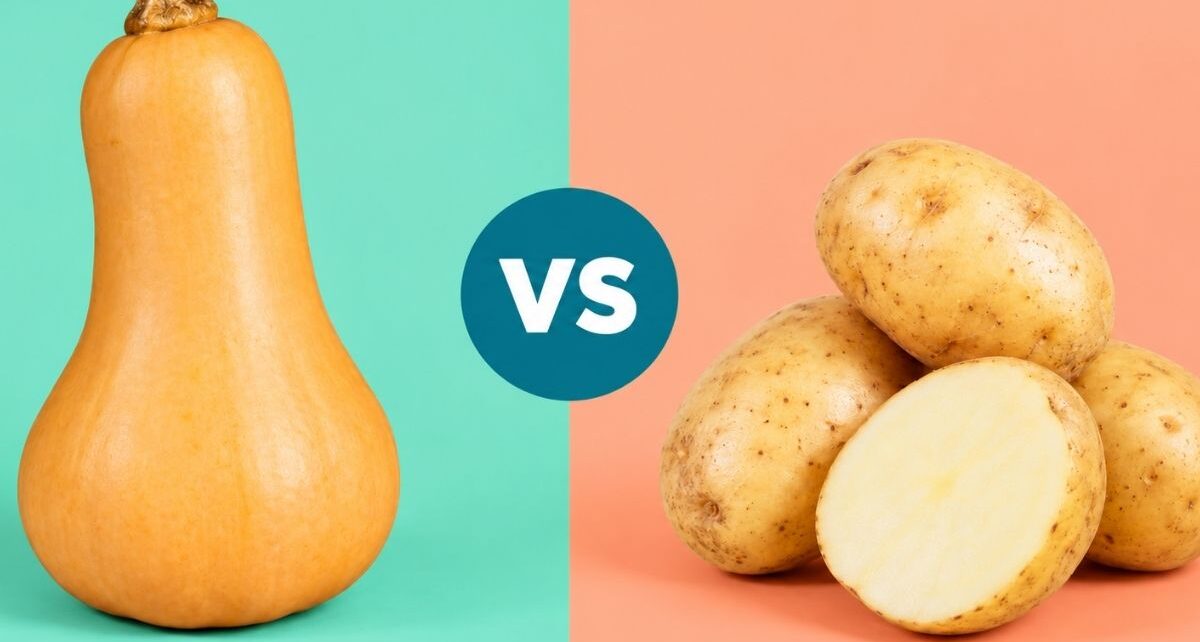
Butternut squash and potatoes often end up in the same place on the plate. Both can be roasted in cubes or served as a warm side dish, so comparing their calories makes a lot of sense.
The numbers floating around online can look a little dramatic, though. One of the more common claims says that butternut squash has roughly half the calories of potatoes.
We compared equal cooked weights to test that claim. The difference is not an illusion caused by portion size; the numbers provide a solid basis for it.
For the baked versions, 100 grams of butternut squash has about 40 kcal, while the same amount of white potato has about 92 kcal. In other words, butternut squash has about 57% fewer calories in this comparison.
So, “half the calories” is a fairly reasonable short description. But calorie density is only one factor to consider before replacing potatoes with squash in every meal.
Where Does Such a Big Difference Actually Come From?
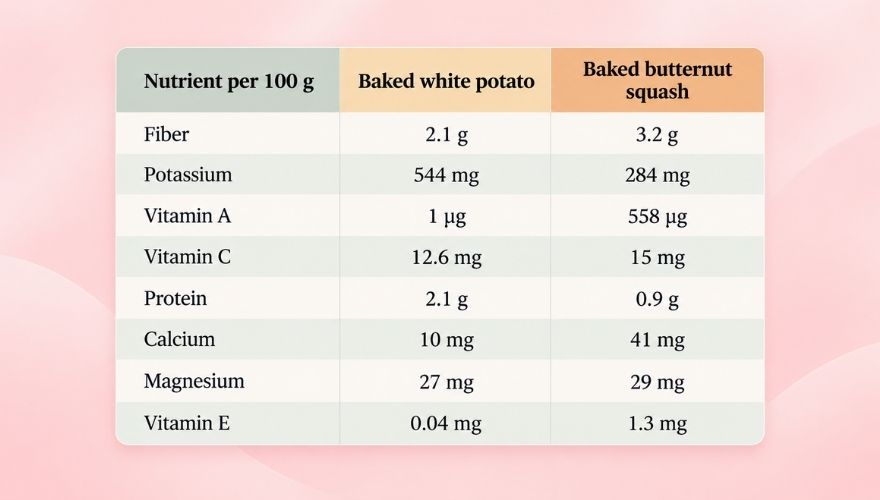
The biggest difference comes from the amount of carbohydrates.
Per 100 grams, baked white potato has about 21 g of carbohydrates, while baked butternut squash has about 10.5 g. The calories follow that ratio fairly closely: about 92 kcal for the potato versus 40 kcal for the squash.
Still, calories show only one part of the difference. When you look at the other nutrients, both foods have their own advantages.
Why Does Butternut Squash Have Fewer Calories?
Butternut squash contains a lot of water, and at the same weight it has less starch than potatoes. That ratio allows for a relatively large portion with a lower calorie intake. Although sweet potatoes and regular white potatoes have different nutritional profiles, the same basic principle helps explain the difference: squash contains less energy in the same amount of food. For someone who wants a large side dish with fewer calories, that can be very useful.
Did you know you can lose weight while eating butternut squash? As the Weight Loss Guide explains in its YouTube video, it is low in calories and high in fiber, which may help control appetite. Watch the video to learn more about its weight-loss benefits and nutritional value.
Fewer Calories Still Do Not Tell You Which One Will Keep You Full Longer
If we compare calories alone, butternut squash easily wins this round. If the question becomes “which one will keep me full longer,” the answer becomes much more interesting.
Potatoes have more starch and more energy at the same weight. In our previous article about vegetables and satiety, we examined a well-known experiment in which boiled potatoes scored very high on the satiety index.
Butternut squash offers a larger amount of food for fewer calories. Potatoes provide more energy and can leave you with a different feeling after the meal.
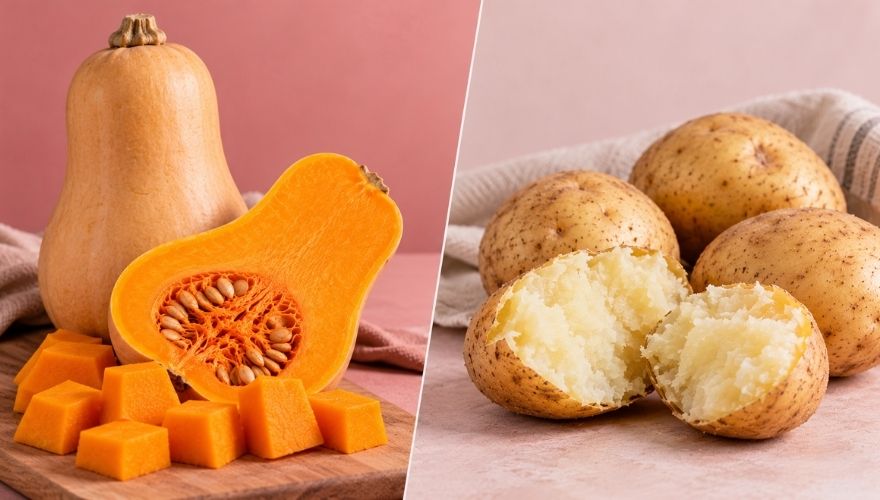
Both have their own advantage over the other food in this comparison. If your main goal is calorie density, squash has the advantage. If you are making a meal that needs to keep you full for several hours, baked white potatoes are the better option.
Butternut Squash Has More Sugar Than You Might Expect
Another interesting point appears when we look only at sugars.
Per 100 grams, baked butternut squash has about 1.97 g of sugar, while baked white potato has about 1.53 g. Potatoes still have twice as many total carbohydrates. Potatoes get most of those carbohydrates from starch. Butternut squash has a sweeter taste and a somewhat different ratio of sugar to starch.
So taste can be misleading here. The sweeter food in this case still has far fewer total calories.
What About Fiber?
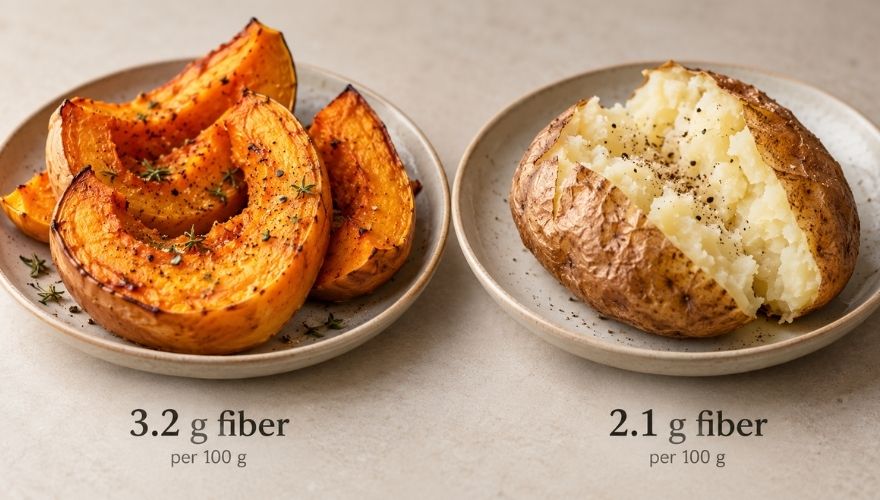
There is a difference in fiber, but it is not huge.
Per 100 grams, baked butternut squash has about 3.2 g of fiber, while baked white potato has about 2.1 g. That means butternut squash provides about 50% more fiber at the same weight.
With larger portions, the difference becomes more noticeable. One cup of baked butternut squash, about 205 g, contains approximately 6.6 g of fiber.
The comparison per 100 grams is more useful here. It puts both foods on the same footing without the effect of different portion sizes.
In the end!
Yes, the claim is pretty close to the actual numbers when we compare the same weight of baked foods.
However, butternut squash gives you a larger amount of food for a certain calorie budget. Potatoes provide more starch and energy at the same weight.
If you track calories, butternut squash can lower the calorie value of a side dish. For the whole meal, consider satiety, the amount of protein, added ingredients during preparation, and portion size.