
Nutrition labels can make even a familiar food worth a second look. Celery is a good example because its low calorie content has inspired a claim that deserves a closer examination.
The claim that celery burns more calories than it contains has circulated for years. Does celery really have negative calories? No
The body uses energy to digest it, but available research shows that the energy spent does not exceed the energy celery provides.
We compared USDA calorie figures with published studies on the energy required to digest celery. The results put a familiar food myth into perspective.
- Raw celery contains approximately 14 calories per 100 grams, according to USDA data.
- Digesting celery requires energy, but there is no reliable evidence that the energy spent exceeds the food’s calorie content.
- A study of 15 women found an average additional energy expenditure of 13.76 calories after a 16-calorie meal.
- Even prolonged chewing does not prove that celery has a negative energy balance.
- Celery can reduce your total calorie intake if you use it to replace a higher-calorie snack.
How Many Calories Does Celery Really Have?
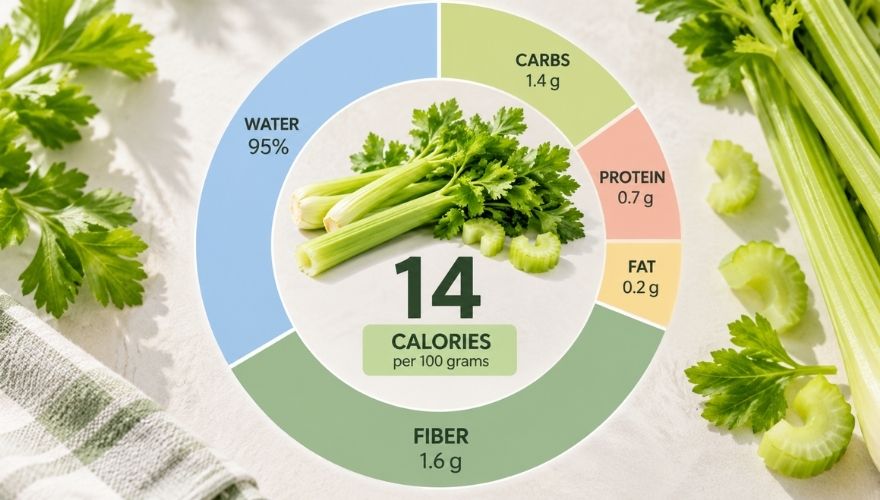
About 14 kcal per 100 grams According to USDA FoodData Central, 100 grams of raw celery contains approximately 14 calories.
About 95% of its weight is water. The same amount contains approximately 1.6 grams of fiber.
Due to its high water content, a serving of celery can take up quite a lot of space on your plate while providing relatively little energy.
Imagine a 300-gram package you’ve just brought home from the supermarket. If you eat the entire amount, you’ll consume approximately 42 calories.
How Many Calories Does Your Body Burn While Digesting Celery?
The body uses energy to process food. Some of that energy is needed for digestion, and some for the absorption and subsequent processing of nutrients.
The total additional energy expenditure is known as the thermic effect of food. In an average diet, approximately 10% of total daily energy expenditure goes toward processing food, according to the Academy of Nutrition and Dietetics. However, that percentage is not the same for every food.
Celery is particularly interesting because of its low calorie content. Even a relatively small amount of energy spent on digestion can represent a large percentage of the energy you consume.
That is precisely where the popular negative-calorie claim comes from. People assume that celery’s fibrous structure requires so much chewing and digestive effort that the body ultimately burns more energy than it receives.
But how much energy does it actually take to process 100 grams of celery? We have concrete results from a scientific experiment that can answer that question.
A Scientific Study Found That 86% of Consumed Calories Were Burned
In 2013, the results of a study by researchers Miriam Clegg and C. Cooper from Oxford Brookes University were published.
The experiment involved 15 healthy women with an average age of 23.5 years. After an overnight fast, the researchers measured their resting energy expenditure.
Each participant then ate 100 grams of raw celery, which provided 16 calories. Additional energy expenditure was measured over the next three hours.
The Result?
| Per 100 Grams of Celery | Calories | Percentage |
| Energy consumed | 16 kcal | 100% |
| Energy expended | 13.76 kcal | 86% |
| Difference | +2.24 kcal | 14% |
The 86% figure is striking, but the most important point is that total additional energy expenditure did not exceed the calorie content of the meal.
The experiment also has certain limitations.
Only 15 women participated, and the measurements lasted three hours. Therefore, the result cannot be applied as a precise calculation to every person.
Another interesting experiment was conducted later, this time on bearded dragons. Researchers measured how much energy the lizards used to process celery and how much energy they lost through excretion.
In a paper published in 2019, the animals retained approximately one-quarter of the energy they consumed through celery.
Since the study involved animals, we cannot directly apply the results to humans. Still, both experiments show that celery’s low calorie content does not automatically mean it has a negative energy balance.
How Can You Prepare Celery Without Adding Many Extra Calories?

Raw celery is the simplest option, but there is no need to limit it to a snack. Preparation can significantly change its flavor and texture, and the amount of added oil or other ingredients determines how many calories the final meal will contain.
Here are a few simple ways to prepare it:
- Raw celery: Cut the stalks into sticks and serve them with a little nonfat Greek yogurt. A 100-gram serving of celery contains approximately 14 calories, without any additions.
- Boiled celery: Add chopped stalks to vegetable soup. They soften during cooking, and the celery itself does not add many calories. For an accurate calculation, take the other ingredients into account as well.
- Roasted celery: Cut the stalks into larger pieces and roast them in the oven at 200°C for approximately 20 minutes. Add seasonings to taste, and measure the oil because one teaspoon contains about 40 calories.
- Sautéed celery: Briefly sauté it in a pan with a little water, then add garlic. If you use oil, include its calorie content in your calculation.
- Celery juice: Wash the stalks and extract the juice with a juicer. The resulting drink contains less fiber than whole celery, so it should not be treated as a complete substitute for the fresh vegetable.
If your goal is to keep added calories low, raw or boiled celery makes the calculation easier.
Here Are a Few Other Things You Might Find Interesting
Does Celery Have Fewer Calories When Cooked?
Cooking can change the amount of water in celery. As a result, its calorie content per 100 grams may be different, but cooking alone does not remove a significant amount of energy from the food.
Does Celery Juice Burn Calories?
No. Celery juice does not cause any special calorie-burning effect. In addition, juicing removes some of the fiber found in the whole stalk.
Can Celery Help You Lose Weight?
Celery can contribute to a lower calorie intake if you use it to replace higher-calorie foods. However, weight loss depends on your overall energy balance over a longer period.
Are There Other Negative-Calorie Foods?
There is no reliable evidence that foods commonly found on such lists, such as cucumbers or lettuce, require more energy to process than they provide to the body.
Conclusion
Celery is low in calories, but it does not have a confirmed negative energy balance. Research on humans has shown that processing celery can require a large portion of the energy consumed, but not more than that.
Still, something else matters more in your everyday diet. Celery can replace a higher-calorie snack and help reduce your total calorie intake. It does not need negative calories to provide that benefit.