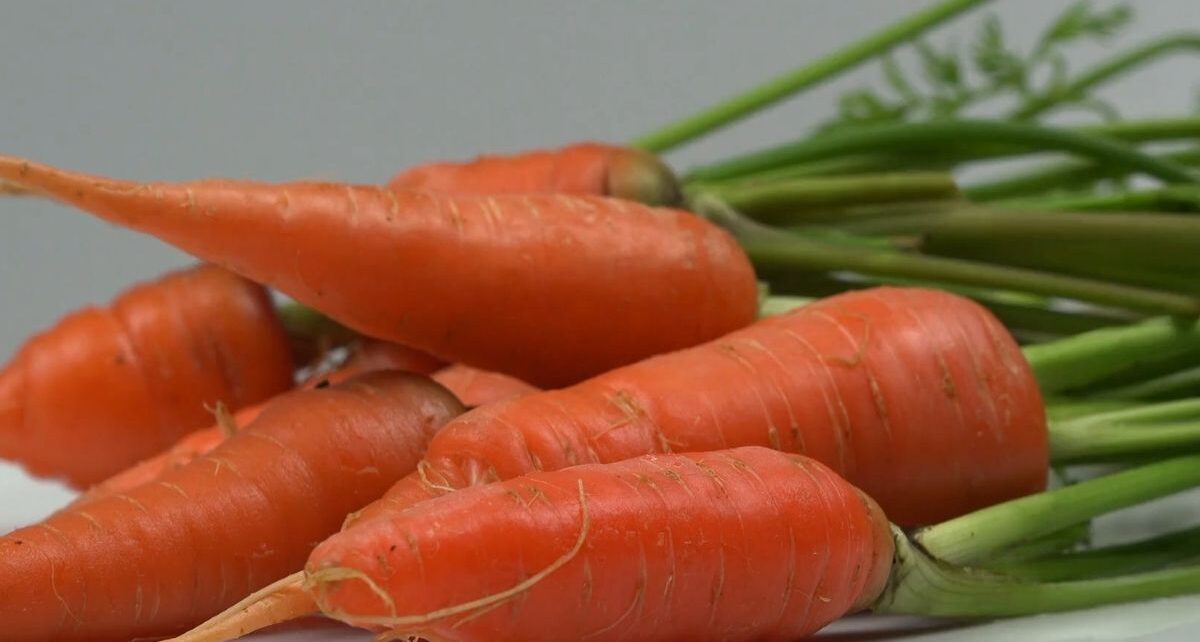
Raw carrots contain about 41 calories per 100 grams, which puts a medium 61-gram carrot at roughly 25 calories. Boiled and drained carrots come in at about 35 calories per 100 grams. Cooking can change the number you see because water content and final weight change, not because heat simply removes calories.
So how many calories in carrots are there, and does cooking change the number?
The same issue comes up throughout carrots nutrition data. Baby carrots have their own values, portion sizes differ among databases, and a cooked side dish can become far more calorie-dense once butter or a brown sugar glaze enters the recipe.
The Numbers Worth Knowing First
- Baby carrots contain about 35 calories per 100 grams.
- Boiled and drained carrots contain about 35 calories per 100 grams.
- Water content explains much of the difference between raw and boiled values.
- Butter or a brown sugar glaze can add far more calories than the raw-to-boiled difference.
Raw Carrots and Calories in Carrots per 100 Grams

For raw carrots, the cleanest comparison starts with 100 grams. USDA Standard Reference data lists about 41 calories, 9.6 grams of carbohydrate, and 2.8 grams of fiber per 100 grams.
The same amount contains about 88.3 grams of water. A medium carrot in the USDA data weighs 61 grams, so the calculation for calories in carrots is straightforward:
41 × 0.61 = about 25 calories
That gives us a useful estimate for one medium carrot.
The FDA vegetable table uses a larger carrot weighing 78 grams and lists 30 calories. That does not conflict with the USDA figure. The portions simply weigh different amounts.
The same type of discrepancy appears in food specifications. A calorie value can look wrong until the serving weight beside it is checked.
That detail matters with carrots nutrition because words such as “medium” are less precise than they sound. If you need a closer estimate, weighing the edible portion works better than deciding which size category a carrot belongs in.
Why Do Baby Carrots Have a Different Number?

USDA data puts raw baby carrots at about 35 calories per 100 grams, compared with roughly 41 for standard raw carrots.
The difference is small, and water content helps explain part of it. Baby carrots contain about 90.4 grams of water per 100 grams, compared with roughly 88.3 grams in standard raw carrots. More water in the same total weight leaves less dry matter to contribute energy.
That gives calories in carrots another useful lesson: equal weight does not guarantee identical composition.
For a real serving, the difference is modest. A 100-gram portion of baby carrots is only about six calories below the same weight of standard raw carrots, so counting individual pieces usually adds more uncertainty than it removes because baby carrots vary in size.
Why Do Boiled Carrots Drop to About 35 Calories per 100 Grams?
This is where carrots nutrition gets more interesting. Raw carrots sit near 41 calories per 100 grams, yet boiled and drained carrots are closer to 35.
The main clue is water.
Raw carrots contain about 88.3 grams of water per 100 grams. The USDA value for boiled and drained carrots is about 90.2 grams. Once the cooked portion contains more water, 100 grams of finished food contains less original carrot material.
Raw, Baby, and Boiled Carrots Compared
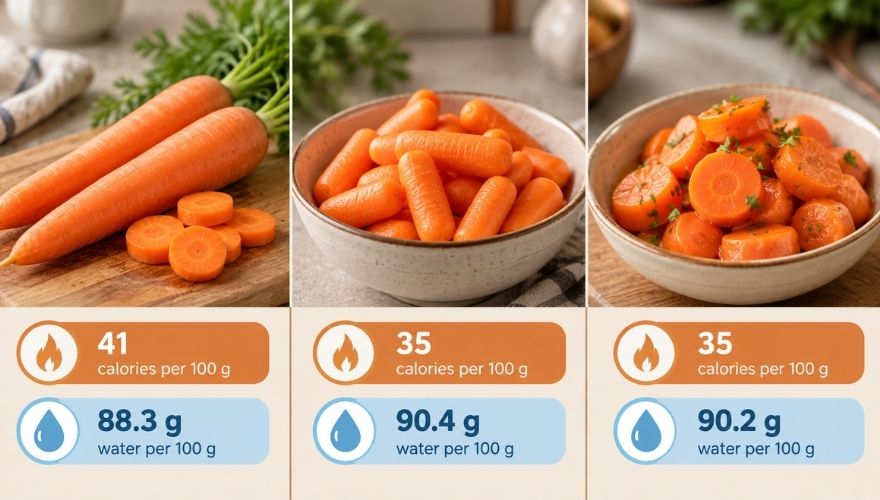
The water column adds something the calorie value alone cannot show. Both lower-calorie entries also contain a higher proportion of water. Did boiling remove six calories?
Not in the simple sense that question suggests. One hundred grams of raw carrot and 100 grams after boiling do not necessarily represent the same starting amount of food. Water has moved into the vegetable, so the denominator in the calculation has changed.
That distinction is one of the most useful parts of carrots nutrition data once you start comparing raw and cooked foods.
What Happens to a Whole Portion After Boiling?
A simple calculation makes the problem easier to see.
Suppose you start with 200 grams of raw carrots. At 41 calories per 100 grams, the starting amount contains about:
2 × 41 = 82 calories
After boiling, the carrots may weigh more because they have taken up water. You cannot take the new value of 35 calories per 100 grams and assume the original 82 calories fell by the same percentage.
The two figures use different weights as their reference point.
For carrots, separate the calories in the starting portion from the value per 100 grams of the finished food. The distinction prevents a common recipe mistake: weighing a raw ingredient and applying a cooked-food database entry to it.
If you weigh carrots raw, use a raw-carrot value. If you weigh them after boiling, use a boiled-carrot value that matches the preparation method as closely as possible. That recommendation works because weight and nutrient data then describe the same form of the food.
Cooking Also Changes Carotenoid Availability
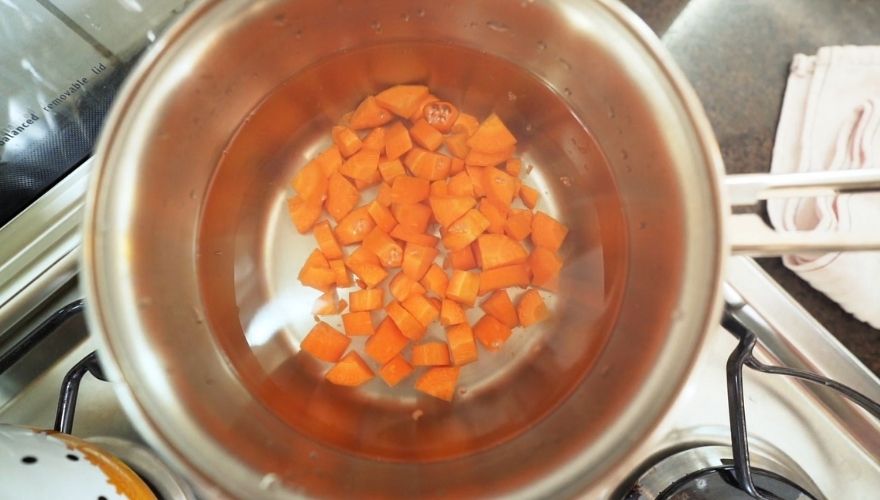
Calories are only one part of carrots nutrition. Carrots are a major food source of carotenoids, including beta-carotene, and food structure affects how much of those compounds becomes available during digestion.
A small 2003 human study tested meals containing 15 mg of beta-carotene from raw chopped carrots or cooked pureed carrots in eight ileostomy volunteers. The researchers calculated beta-carotene absorption at 41.4% from the raw chopped meal and 65.1% from the cooked pureed meal.
The result deserves a careful reading. Only eight people took part, and the cooked carrots were also pureed, so the experiment does not isolate heat as the only factor. Still, it shows that food structure can matter alongside the calorie count.
Research published in 2024 on cooked carrots adds another piece. Boiling, baking, steaming, and microwaving all increased total carotenoid bioaccessibility under the tested laboratory conditions, although the size of the effect depended on the method and intensity of treatment.
That does not make cooked carrots universally “better” than raw carrots. It tells us that a lower calorie value per 100 grams does not imply a weaker nutritional profile.
Butter and Brown Sugar Change the Calculation Much Faster
The difference between 35 and 41 calories in carrots is small compared with what happens once calorie-dense ingredients are added.
Take 200 grams of boiled carrots. At 35 calories per 100 grams, the carrots contribute about 70 calories. One tablespoon of butter, roughly 14 grams, adds about 100 calories. Add one tablespoon of brown sugar at roughly 12 to 13 grams, and another 48 calories enters the recipe.
The estimate becomes:
70 calories from carrots + 100 from butter + 48 from brown sugar = about 218 calories
The calculation assumes all of the butter and sugar remain in the serving. If part of the glaze stays in the pan, the amount actually eaten will be lower.
That limitation matters because recipe totals are estimates unless every ingredient that enters and leaves the pan is measured. Still, the scale of the difference is clear. Cooking carrots in water might shift the database value by about six calories per 100 grams. Butter and sugar can add well over 100 calories to one ordinary serving.
For carrots nutrition, the preparation method and the added ingredients are therefore separate questions. Boiling mainly changes water and weight. Butter or glaze adds new energy.
Why Can Two Apps Show Different Calories in Carrots?
Before deciding that one database is wrong, check exactly what each food entry describes.
One may list raw carrots. Another may use boiled and drained carrots. A third may represent baby carrots, while a packaged product may use manufacturer data.
Serving size creates another difference. The FDA carrot portion is 78 grams and 30 calories, while the USDA medium-carrot example uses 61 grams and lands near 25 calories.
A quick check usually resolves most disagreements:
- Match raw food with raw-food data.
- Check the serving weight in grams.
- Confirm the carrot type.
- Include any added ingredients.
Make those checks before comparing carrot calories across apps. A five-calorie disagreement is not very informative if one app describes a larger carrot.
How Much Do Calories in Carrots Matter in a Normal Serving?

A medium raw carrot has roughly 25 calories. Even the larger 78-gram serving in the FDA table has only 30. So if one carrot weighs a little more than another, the difference is usually only a few calories.
There is little benefit in trying to decide by eye if a carrot contains 25 or 28.
A scale becomes useful when you want a repeatable calculation, especially for a larger recipe. Weigh the edible carrots, use the matching carrots nutrition entry, then add any butter or other calorie-containing ingredients separately.
The recipe can matter much more than the natural variation between individual carrots.
Before we wrap up
For a straightforward estimate, use about 41 calories in carrots per 100 grams when they are raw and about 25 calories for a medium 61-gram carrot. For boiled and drained carrots, about 35 calories per 100 grams is the relevant USDA value.
The more useful habit is to match the number to the food in front of you. Raw weight goes with raw data, cooked weight goes with the matching cooked entry, and butter or glaze gets counted separately.
That approach keeps carrots nutrition much simpler than trying to decide which database has the one perfect number.