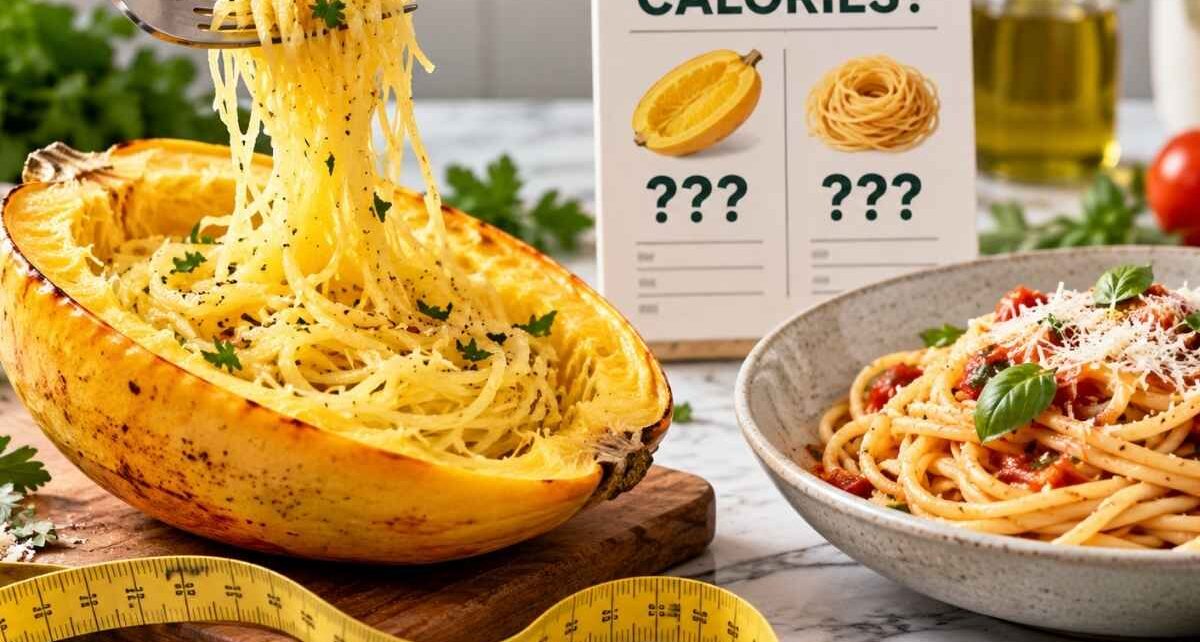
Spaghetti squash has one quality that almost sells itself. Once it is baked or cooked, the inside separates with a fork into long strands that look a lot like spaghetti. That is where the name comes from, along with the comparison to pasta that appears almost everywhere people talk about this vegetable.
The calorie difference certainly gets attention. One cup of cooked spaghetti squash weighing about 155 grams has approximately 42 kcal, while a cup of cooked spaghetti of a similar weight has about 239 kcal. That is nearly a 200-calorie difference between two portions that can take up a similar amount of space in a bowl.
We looked beyond the calorie figure to see what it means in a real meal. Portion size, the form of the food, and added ingredients can all change the final total.
Let’s look at the squash itself first.
How Many calories in spaghetti squash Are There Actually?
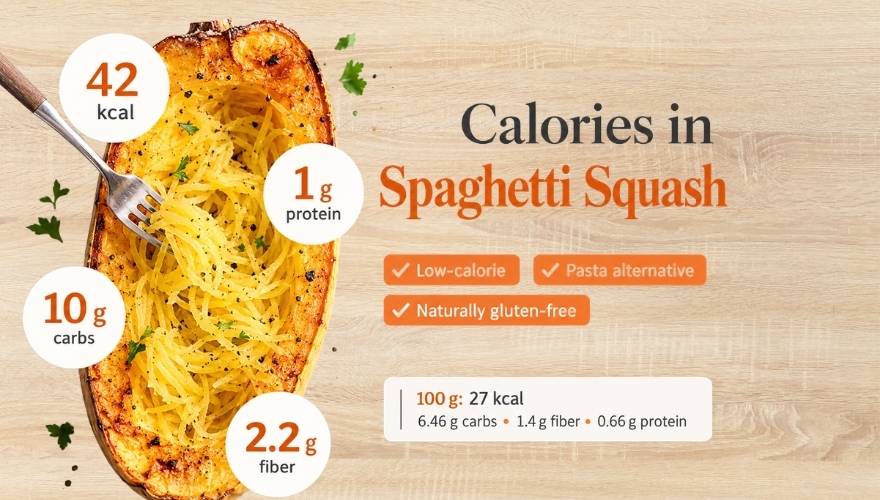
According to nutrition data for cooked, drained, or baked spaghetti squash without salt, 100 g has about 27 kcal, 6.46 g of carbohydrates, 1.4 g of fiber, and 0.66 g of protein. A standard cooked cup of about 155 g provides around 42 kcal, 10 g of carbohydrates, 2.2 g of fiber, and about 1 g of protein.
So the answer to the question about calories in spaghetti squash also depends on the measure you use. One hundred grams and one cup represent different amounts of food, so 27 and 42 kcal describe two different portions of the same food.
Illinois Extension uses exactly a one-cup portion when comparing squash with pasta: 42 kcal and 10 g of carbohydrates in a cup of spaghetti squash versus 197 kcal and 40 g of carbohydrates in a cup of cooked spaghetti noodles.
That comparison is more useful than simply saying squash is low in calories. At a similar volume, it provides considerably fewer carbohydrates and less energy.
Raw and Cooked Weight Give Different Numbers
Raw spaghetti squash has about 31 kcal per 100 g, while the prepared version has about 27 kcal per 100 g. Most of the difference comes from changes in water content during preparation.
That is where calories in spaghetti squash can easily become confusing. If you have baked squash on the scale but choose a nutrition entry for the raw food in an app, the comparison is now using two different versions of the same food.
Match the database entry to what you actually weighed. For baked strands, use prepared-spaghetti-squash values; for a whole raw squash, use the raw-food entry.
We explain the same principle in more detail in Raw vs. Cooked Vegetables.
Can Spaghetti Squash Really Replace Pasta?
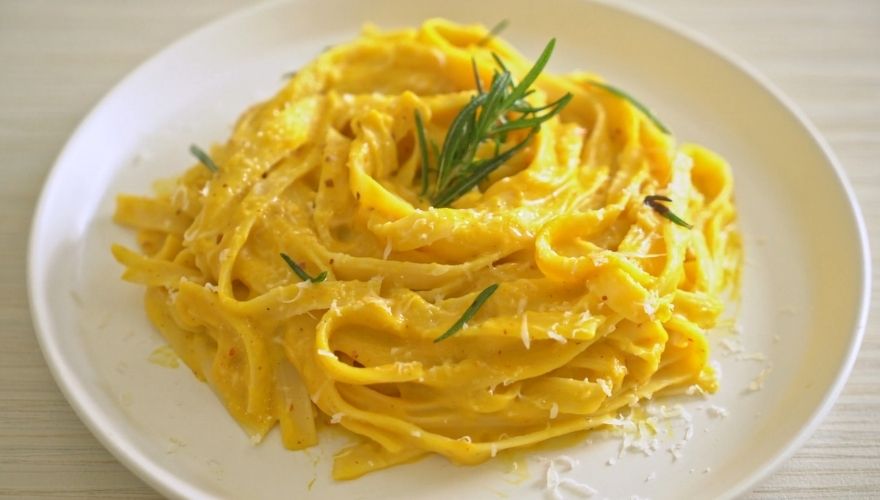
In terms of its role on the plate, it can do that very well. After cooking, you get strands that work easily with tomato sauce, pesto, meat sauce, or cheese. Its mild flavor leaves enough room for the other ingredients.
From the standpoint of calories in spaghetti squash, the substitution has a major advantage for someone who wants lower calorie density. The texture, however, remains different. Pasta gives you a firmer bite and more starch, while spaghetti squash is softer and more watery.
A half-and-half version offers a useful middle ground. Regular pasta keeps the familiar bite, while squash adds volume with relatively few calories. It also avoids presenting two different foods as if they had identical textures.
How Long Will a Meal Like That Keep You Full?
One cup of spaghetti squash provides about 2.2 g of fiber and roughly 1 g of protein. The high water content increases the volume of the portion, so the bowl can look very generous with a low energy intake.
Here, calories in spaghetti squash represent only one part of the satiety story. Water and fiber can contribute to a feeling of fullness during the meal, while the time between meals depends more on the entire plate.
Chicken, turkey, fish, beans, or lentils add protein. Some fat and a source of carbohydrates can further change how long the meal keeps you full.
A large serving of spaghetti squash works better as a base for a meal than as a complete meal on its own.
Sauce and Cheese Can Change the Math Quickly
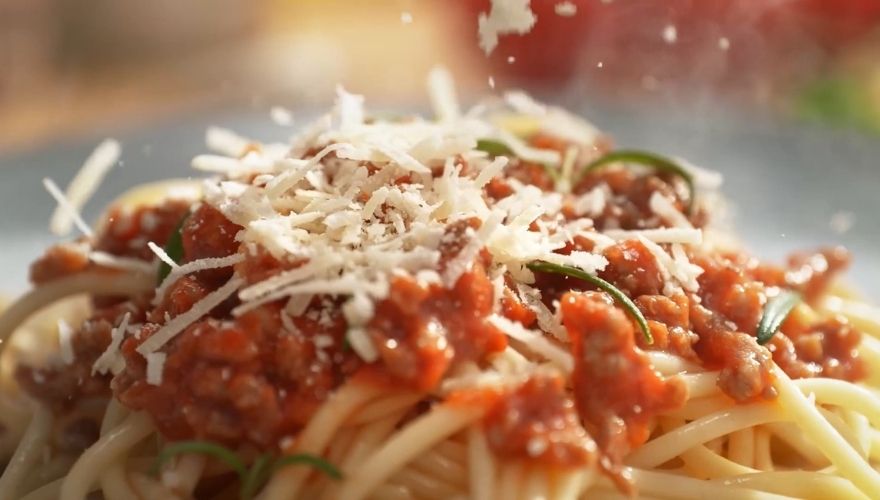
The squash itself leaves plenty of room in a calorie budget. When calories in spaghetti squash are treated as the calories in the finished dish, the result can easily become misleading.
Tomato sauce can keep the meal relatively light. Oil, butter, Parmesan, or a creamy sauce can quickly raise the total. The same applies to a large amount of ground meat or other additions.
Calculate the squash first, then add the other ingredients separately. That makes it easier to see which ingredients account for the calorie total of the finished dish.
That way I can see exactly where the energy in the whole dish comes from.
With a simple meal, the difference can be huge. With a rich sauce, most of the calories may come from the additions.
Looking for a simple way to enjoy spaghetti squash? Check out this quick and delicious recipe from Lidia Bastianich
How Does Spaghetti Squash Fit Among Other Squashes?
Spaghetti squash and butternut squash both belong to the winter squash group, but they play fairly different roles on the plate. Butternut has a denser, sweeter texture, so it often ends up as a puree or roasted side dish. Spaghetti squash produces fibrous strands and naturally invites comparison with pasta.
In Does Butternut Squash Really Have Half the Calories of a Potato?, we explain how the balance of water and starch affects calorie density. With spaghetti squash, that relationship becomes even clearer because water accounts for a large share of its weight.
Such comparisons are most useful when the measurements stay the same. One hundred grams versus one hundred grams, or one cup versus one cup, gives a clearer picture than two arbitrary portions.
Do calories in spaghetti squash Justify Replacing Pasta?
If you want to reduce calories and carbohydrates in the base of the meal, the answer is fairly clear. Illinois Extension reports 42 kcal and 10 g of carbohydrates per cup of spaghetti squash, compared with 197 kcal and 40 g of carbohydrates in a cup of cooked noodles.
If you want the classic texture and more starch, pasta has a very different role. Spaghetti squash works more as a lighter base for the same type of sauce.
The most useful figure for calories in spaghetti squash is still 42 kcal per cooked cup. That number shows how large a portion you can get with a low calorie intake.
Still, we are talking about two different foods. If you love pasta, flavor and texture will probably matter as much as calories.
Match the choice to what you want from the meal. For a large portion with less energy, spaghetti squash has a clear advantage.
For a classic plate of pasta, real pasta remains a different experience. And if you want something in between, a combination of half pasta and half squash offers a very good compromise.
In the context of the whole meal, that flexibility may be spaghetti squash’s biggest advantage.